We all know the call of the open road — mountain passes, surprising detours, the scenic route. But it’s important to remember that not all road trips are created equal. You can plan for rush hour and construction. But what about unexpected emergencies, like when I was driving around Montana and all the hotel rooms were full because Evel Knievel’s son was performing? Suddenly the romance runs low and you’ll stay anywhere that will have you.
I know this, because it has all happened to me. I’ve driven from my childhood home in Minneapolis out to college in Maine. That was in ancient times, when my dad and I referred to a printed road atlas and listened to five CDs of The Great Gatsby. In those days, before the iPhone, I wrote down names of good radio stations, fly-fishing shops and barbecue joints in case I passed that way again.
We’re a long way from that. With our phones, we can guess what time we’re going to arrive, know where police are hiding and get insider advice about dining detours along the way. Most of that is good, but you still want some surprises on the road. Here are some seemingly simple rules that will help you get from point A to point B with your sanity intact.

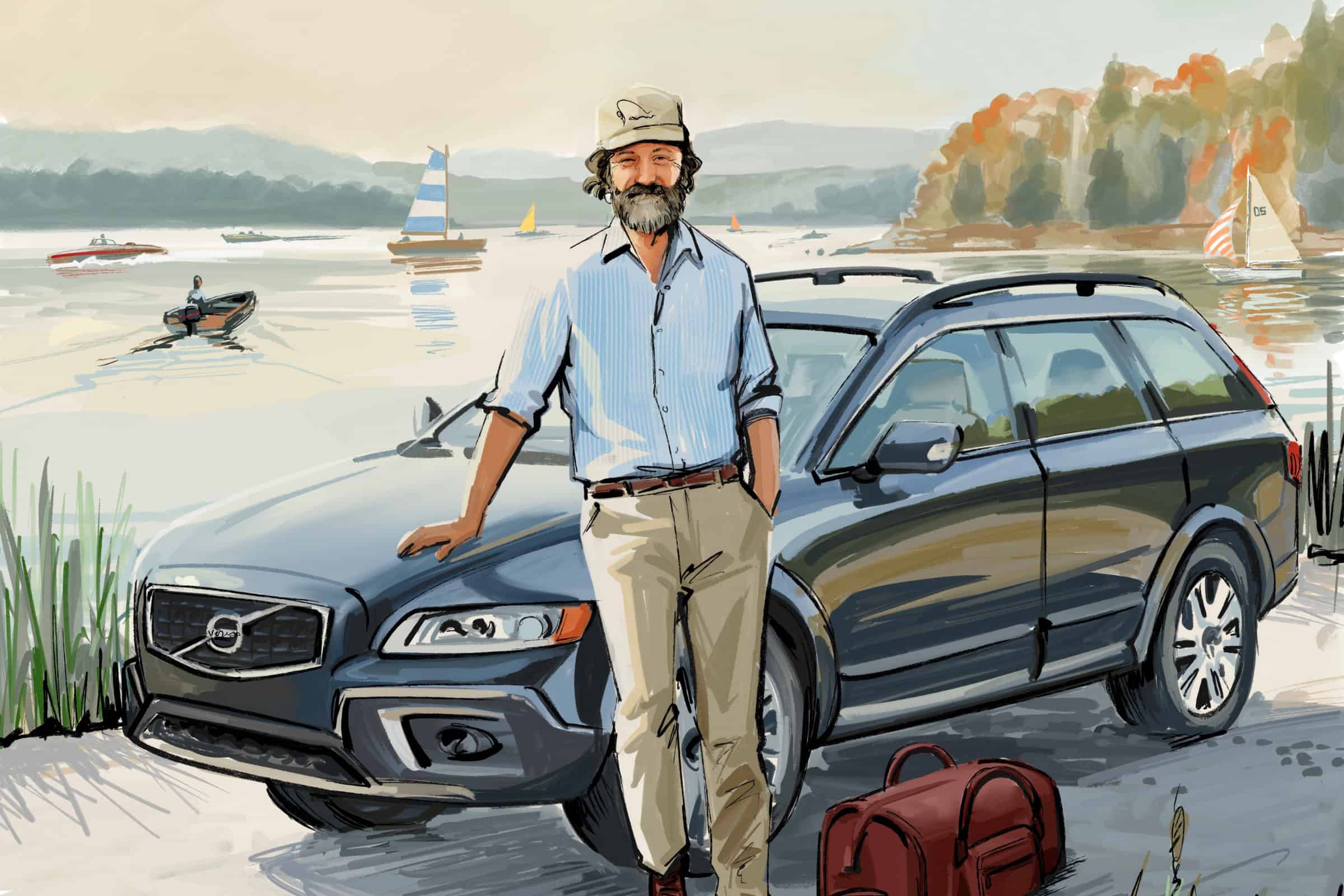
Illustration by Hilbrand Bos
Be prepared, but not too much.
It’s good to have something to look forward to — a Frank Lloyd Wright house, an antiques market, a small town with a great main street — but you want to give yourself room to discover something new. That usually means opting for smaller roads and taking your time. I support a road trip that isn’t a white-knuckle battle with a bunch of semis on the interstate. If I’m on the Dan Ryan Expressway entering Chicago at rush hour then I’m doing it wrong.
Pack one good meal.
Hungry people who’ve been in a car for six hours are not in the right frame of mind to make good decisions. If you’ve arranged your dining itinerary ahead of time then I applaud you. There are other options. When I leave our cabin in Wisconsin and head back east, I bring one good homemade meal to have somewhere along the way. It’s something to look forward to and makes the experience more personal than a chain restaurant at a truck stop.
Get in audiobook mode.
Hunter S. Thompson’s letters, Fear and Loathing in America, E.B. White’s essays, One Man’s Meat, maybe The Breaks of the Game by David Halberstam — these are great books and even better company. But plan ahead; you don’t want to be arguing about Moby Dick or Jane Austen behind the wheel. If you can’t agree on something then it’s going to be a true crime podcast, if you haven’t burned through those already.
Don’t worry about making good time.
This is hard. Highways invite speed. I try not to mark exactly when I set out so I’m not trying to beat some imaginary arrival time. If you’re tearing up the asphalt, you’re less likely to stop for something interesting, and, of course, there are still those state patrol officers waiting to write you a ticket. It’s just too intense.
Plan around scenery.
Sometimes you need to get somewhere in a direct line, but this is rarely the most fun. My favorite drives are around coastal Maine, which is so lovely you practically have to pull off and take a break. Similarly, heading from Livingston, Montana, down to Stanley, Idaho, is going to take your breath away. Or drive up Route 7 in the Berkshires and into Vermont. It’s a perfect road that allows you to stop for antiques, at Edith Wharton’s house or anywhere else that catches your eye. You’re trying to cover ground, yes, but you’re also trying to connect with what you’re passing. That’s why you’re not on a plane.
Embrace the versatile wardrobe.
Now it feels like there are more good places to stop than ever — ambitious restaurants where you’d least expect it or college museums with smart exhibitions. You want to be ready for whatever you come across. No need to go wild; I find a chore coat and a pair of loafers go a long way. The joy of having your own car, however, means that you can stash a sport coat in the back. A rain coat is a good idea. And in my case, there’s always a fly rod and waders tucked into the back of my ancient Volvo wagon. After all, you never know when you’re going to make a fishing detour, and the traveling angler always has to be prepared.
A Minnesotan turned New Yorker, David Coggins is the author of the New York Times bestseller Men and Style and writes a recurring column for Artful Living.