Brett Taber still thinks about his middle school American history teacher. His name was Bob Jensen, and by the time Brett walked into his rural Iowa classroom, Bob had returned to teaching after retiring from a decades-long career in education, farming and coaching baseball. His desire to continue impacting young people’s lives had brought him back to the best place to help shape the next generation: schools. What sticks with Brett the most was Bob talking about integrity, defending others and the responsibility we have to the communities we belong to. “We, not me,” he would say.
Today, Brett serves as the Vice President of Social Impact for the Minnesota Vikings, helping determine how one of the most recognizable organizations in the Midwest uses its influence to impact the community. It’s a full-circle moment to think that something taught by a middle school teacher years ago now echoes through an NFL organization capable of reaching millions of people. And from time to time, Brett still finds himself wondering what Bob would do.

Photography provided by “Rise to More”
I met Brett at the Vikings’ TCO Performance Center for a conversation on my Rise to More podcast. As we talked, we were surrounded by immaculate fields, players moving through the building and others warming up behind us — reminders everywhere that this organization exists for the very public pursuit of winning football games. But the longer we talked, the less I found myself thinking about sports at all.
Brett’s own career with the Vikings started inside a mascot costume. Shy by nature, he found that putting on a costume gave him permission to step outside himself. He could enter a hospital room and make a sick child smile or walk onto a neighborhood football field and watch crowds light up with recognition and excitement. That’s where he learned the power of influence: People give you their attention, and then you decide what to do with it.

Photography provided by the Minnesota Vikings
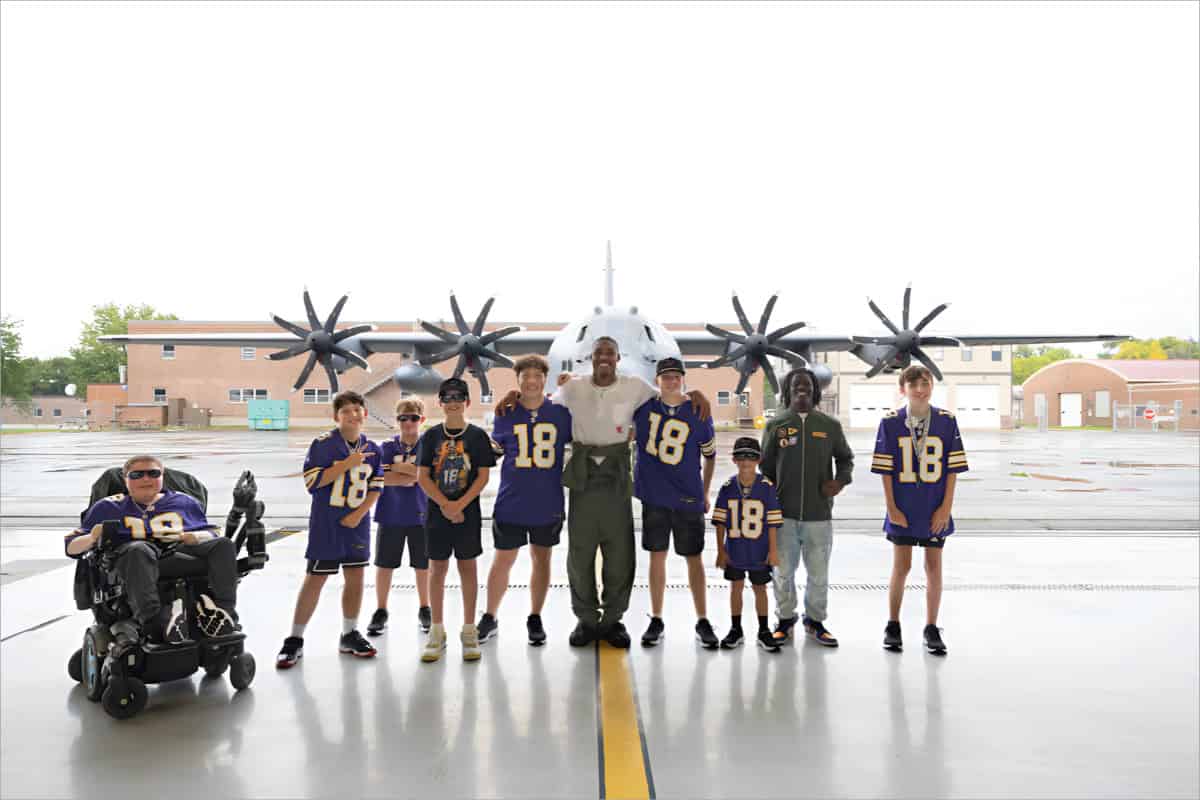
Today, he sees that same magic when players like Justin Jefferson spend time with children facing serious illnesses through Make-A-Wish. Brett shared that when Jefferson was asked to participate, there was no hesitation, just a willingness to show up. It may seem like a small gesture from someone whose presence means so much, but it makes you wonder if, decades from now, one of those children will remember Justin the way Brett remembers Bob Jensen.
Sports offer an unusual amount of that attention. Brett refers to them as “the last great unifier,” and I understood immediately what he meant. I grew up in Bosnia and Herzegovina, a country that knows all too well what division can cost in the wake of civil war. I’ve also seen what happens when sports bridge those differences and give people something joyful to belong to together.
The Vikings hold some version of that uniting energy in Minnesota. Families pass down their loyalties and children grow up recognizing the team logo and chanting “Skol.” People remember games not only for monumental plays, but also because of the shared energy in a room and who was sitting beside them. Brett’s work begins with a deceptively simple question: If a community has embraced you, why wouldn’t you want to care for it in return?

Photography provided by the Minnesota Vikings
That philosophy can be seen in programs like Vikings Table, which provides more than 100,000 meals across the Greater Twin Cities, and in the extraordinary growth of women’s and girl’s flag football. What began as a program with four teams has grown to support 104 varsity high school teams, along with nine Division II and III college programs in the region. Brett told me about a young woman from Camden High School in North Minneapolis who has committed to the College of Saint Benedict to continue both her education and her flag football career.
That detail caught my attention as an alumna of Saint Benedict, but for another reason: I know what it means when someone opens a door that alters the trajectory of a life. I grew up during the war in Bosnia and spent time in a refugee camp. There were people along the way who helped me through acts of generosity or opportunities they may not have considered extraordinary. Their kindness didn’t end when it reached me. It became part of what I would eventually give to other people.
Perhaps that’s why Bob’s story stayed with me.
“We all have a Bob in our lives,” Brett told me. Someone, somewhere showed us something about the kind of person we could become. A teacher, parent, coach, neighbor or stranger behaved in a way that made us believe in goodness. Most may never know the full impact of their presence.
Photography provided by the Minnesota Vikings
Brett hopes some of the programs he’s building will eventually become unnecessary. He wants his three-year-old daughter to grow up in a Minnesota where girls playing varsity football is so ordinary that nobody thinks to call it progress. And there’s something beautiful about building something you hope the world eventually outgrows.
A retired farmer returned to a classroom because he still wanted to affect young people’s lives. He couldn’t have known that one of those students would someday sit inside the Minnesota Vikings organization using his “we, not me” mantra as a North Star. Most of us never get to know where the good we put into the world eventually goes. Maybe we don’t need to.
Listen to the entire conversation on the Rise to More podcast, streaming now.