Three well-worn wine bottles stand on a wooden table between an upturned queen conch and half-melted pillar candles flickering in the tradewinds at Sugar Mill, the beachfront restaurant at Rosewood Little Dix Bay on Virgin Gorda in the British Virgin Islands. The liquid inside? A 2021 cabernet sauvignon, though the identifying labels were long ago eaten away by the saltwater. After all, this wine was aged under the sea.
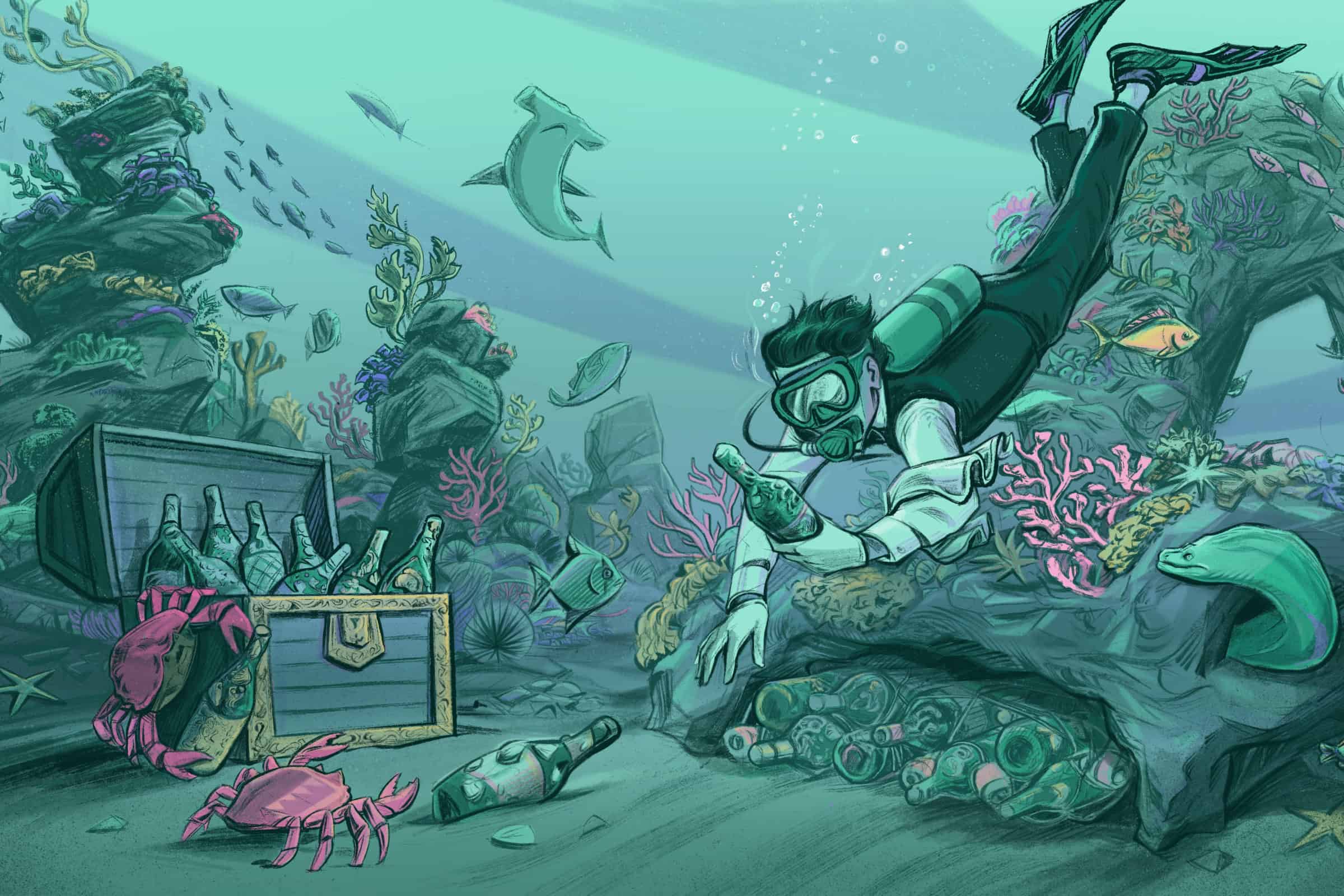
“When I first got here three years ago, I dumped 280 bottles into the sea,” Executive Chef Andy Gaskin tells me. At 64, he’s fit and his forearm muscles tense beneath a tattoo spelling Alfie (the name of his baby grandson) as he uncorks a bottle.
“It’s about 62 feet down,” he says of the round-trip free dive that he does in two minutes and 10 seconds to bring bottles to and fro. At this depth, the temperature remains a fairly constant 57 degrees. “Perfect for aging red wine.”
Gaskin has worked all over the world, from his native London to Sicily, Italy, and from Bangkok to Bora Bora, French Polynesia. But it was in Croatia in 2015 that he first encountered ocean-aged wines. With its thousands of islands and 1,100-mile spool of calm Adriatic coastline, the Mediterranean destination is ideally suited to the process, which is starting to take off in the mainstream as a viable — maybe even preferable — alternative to traditional cellar aging.
“There are four reasons for the madness of why we do this,” says Paul Saranovich, strategic advisor at Wine of the Sea, the United States’ first FDA-approved importer of undersea-aged wines. The Milwaukee-based brand’s ocean cellar is 100 feet below the surface at a former mussel farm near the Croatian island of Pag. Here, the darkness, temperature, atmospheric pressure and movement (the most important factor, per Saranovich) are constant. “You know how wine connoisseurs are always going down to the cellar to turn the bottles?” he says. “Our cages rest on the ocean floor, with our wines tied by the neck, so the bottles are essentially floating in the current,” in perpetual, gentle motion.
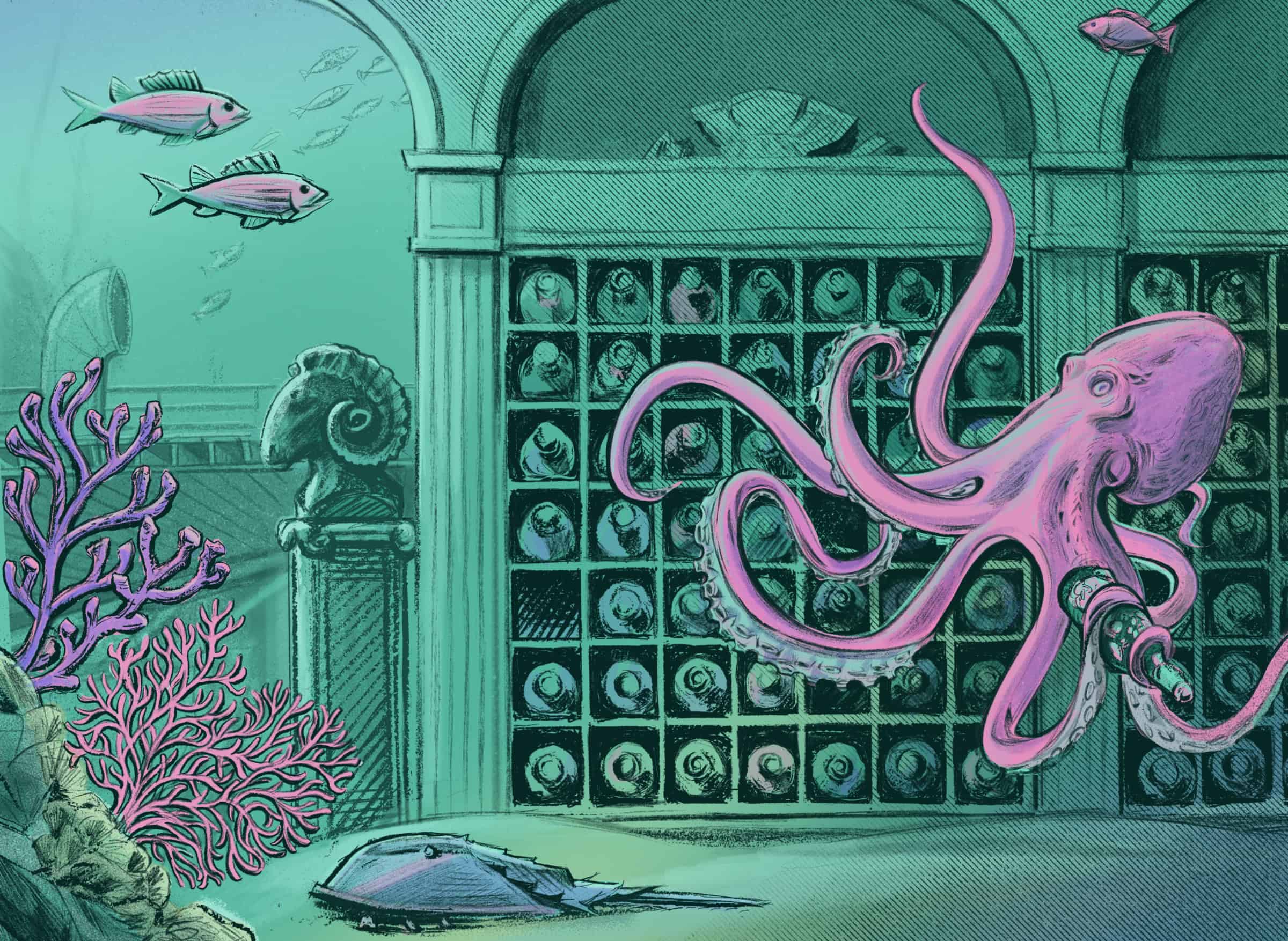
Illustration by Michael Iver Jacobsen
Evangelists of this method describe it as an aging accelerant. The underwater conditions pry open the structure of the liquid at a molecular level — softening tannins, integrating flavors and improving texture. For instance, a 2024 wine,“in the sea for one year, compared to a cellar for one year, will taste and feel like a vintage that was produced in 2020,” Saranovich says. Wines of the Sea counts 20 different wines in its portfolio, from floral Franciacorta to 2018 old-vine Amarone, which wine critic Jonathan Cristaldi called “one of the most irresistible reds you’ll ever taste.” They emerge from the depths stenciled with spaghetti-like coral and start at $200 a pop.
The trend’s origins lie in a Baltic shipwreck discovered by Swedish divers. The Jönköping, likely bound for the Russian imperial court before its fatal encounter with a German U-boat in 1916, went down with a trove of 1907 Heidesieck Champagne. The recovered bubbles caused a sensation in collecting circles — at the prestigious Atlas bar in Singapore, they go for about $150,000 per bottle — and caught the attention of Todd Hahn, a Los Angeles entertainment agent. “We tried to get a hold of it and couldn’t, so we said, ‘OK, let’s do this on our own,’” he says.
Hahn and his partners formed wine distributor Ocean Fathoms in 2015. After giving it a go in California and Oregon, the company now ages in the Mexican Pacific. Their X-factor? Their patented zinc-plated cages that create a galvanic current when they hit saltwater. The electricity, Hahn claims, penetrates the bottles and transforms the wines’ structure.
When Ocean Fathoms brings up 6,000 bottles for its inaugural 2027 vintage, the company will join a competitive market. There are other wines aging underwater in Chile, Spain and Japan. In Australia’s Macedon Ranges, an hour from the coast in Victoria, winemaker Ben Ranken rests his Wilimee pinot noir and chardonnay in tanks filled with water from the nearby dam. In Sardinia, Italy, Cantina Santa Maria La Palma makes Akènta Sub by sinking its sparkling straw-hued vermentino into the Mediterranean. The name derives from a kent’annos, Sardinian dialect for a hundred years. Covered in fossilized marine material, the bottles emerge looking like they’ve been underwater that long, not a mere six to 12 months.
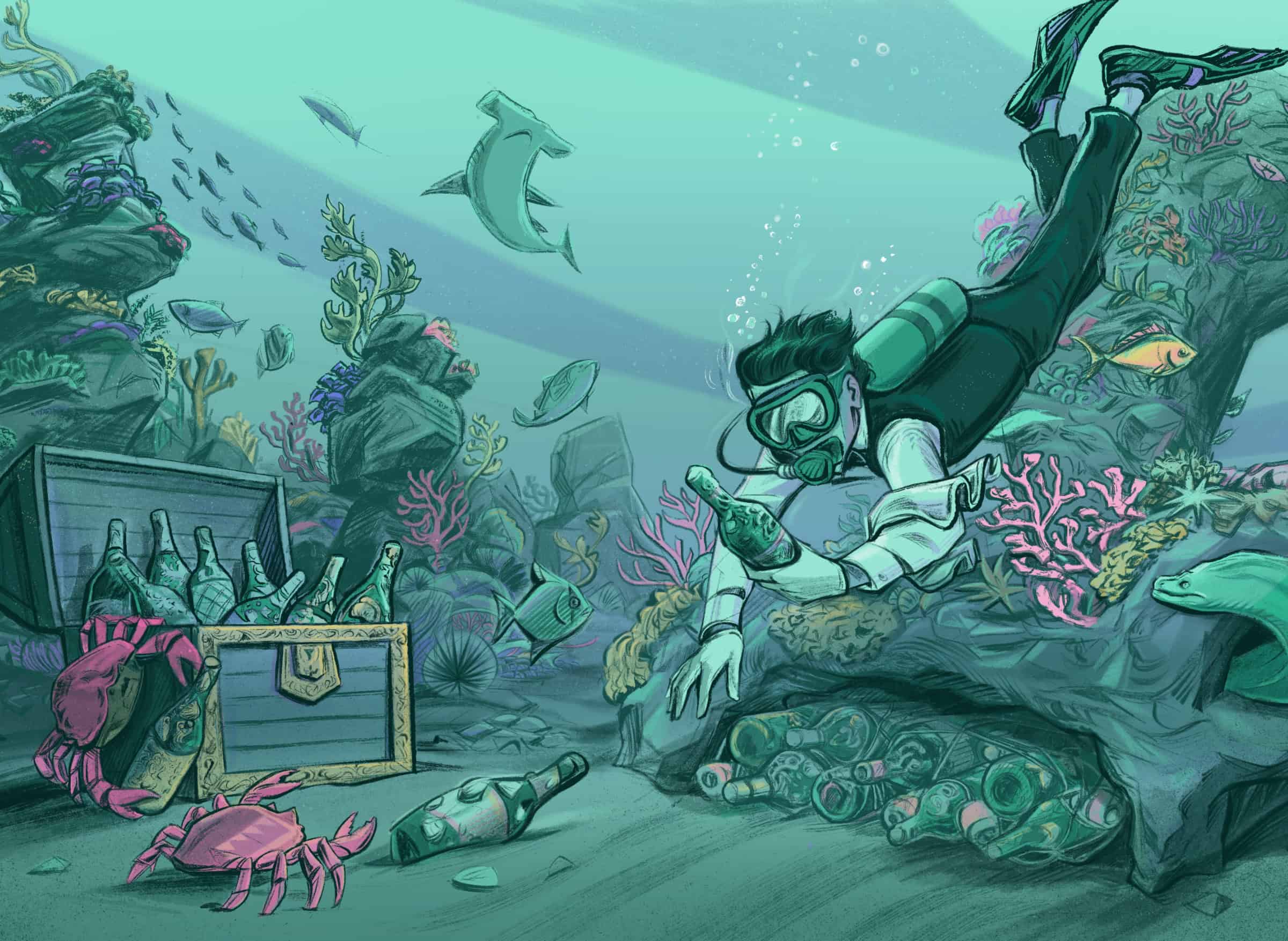
Sugar Mill’s cabernet surfaces with a similar ecosystem of barnacles and seashells, Gaskin says, but they all fall off eventually, leaving behind a cement-like web. He shrugs while filling my glass, less concerned with the packaging than how the wine pairs with the lamb, which was raised on the north end of Virgin Gorda, braised 72 hours, seared and then presented in a theatrical cloud of tableside smoke. “Every one or two mouthfuls, take a sip of this wine,” he urges. “You’ll taste the balance.”
I do as instructed. Aromas of blackberry jam and stewed plums lift off on the surface, and notes of Biscoff cookie spices, black pepper and damp earth dovetail nicely with the lamb’s accents of almond and ginger. Two years in the sea has woven the tannins seamlessly into the wine, creating structure and texture as soft and comfortable as cashmere.
Does this five-year-old wine drink like a 10-year-old? I take another sip. And another. While this is an evocative story these divers are telling — conclusive scientific evidence as to the rapid-aging effects is still forthcoming — there’s no doubt this is delicious, elegant wine that would hold its own at any fine tasting. Nor is there any doubt that more and more bottles will surface, barnacle-crusted and coral-etched, in the years to come.