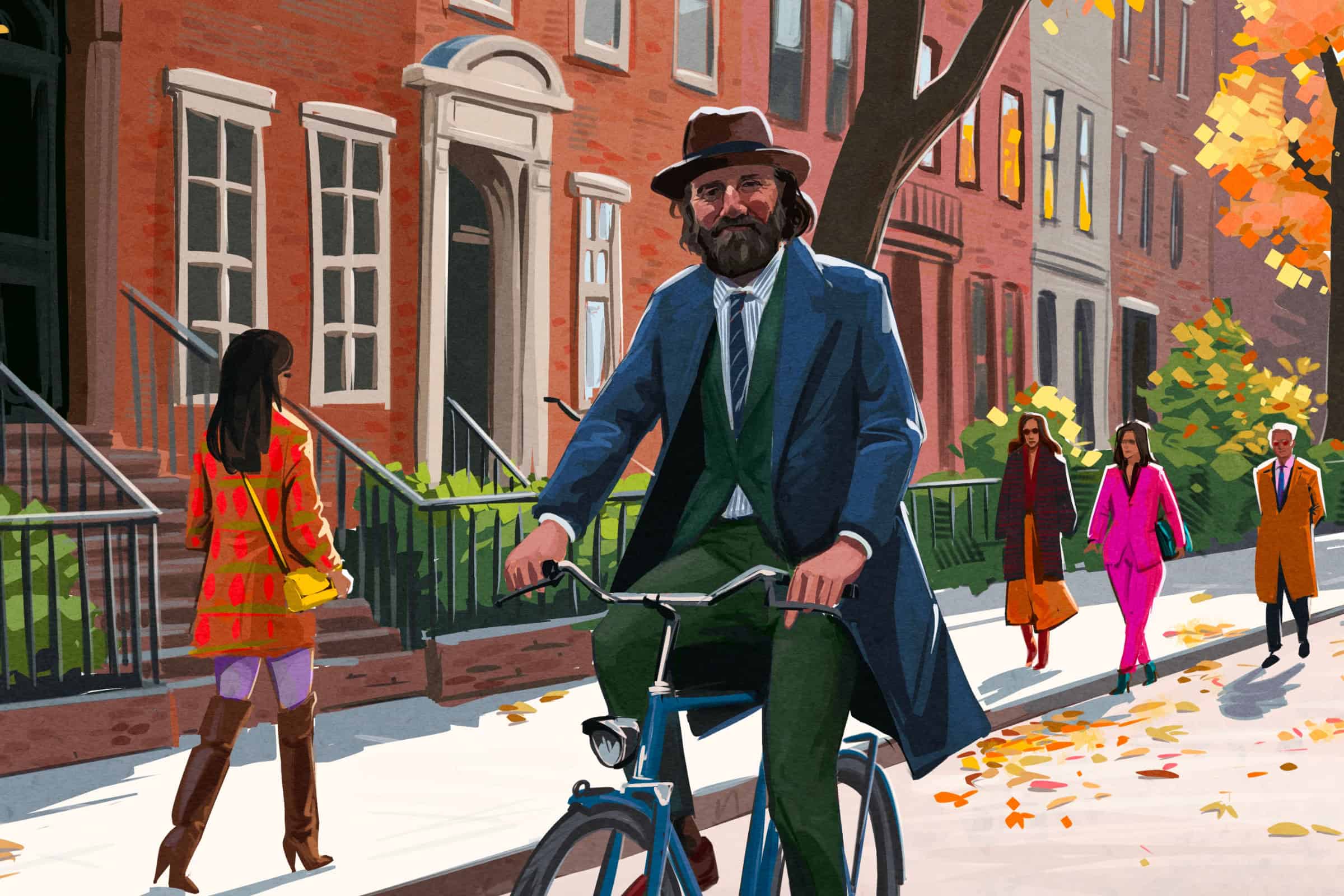
Ιt’s good to have a sense of who you are. This familiarity can reveal itself in welcome sartorial expression. When others cross paths with a confident man, they admire his conviction. This gentleman sets a daring standard, wearing a seersucker suit to a summer wedding or tartan trousers to a New Year’s Eve soirée. He shows what’s possible and gives us the courage to chart our own way.
I remember standing in St. James’ Square in London and noticing a man in a well-tailored gray flannel suit with the shoes of a cultivated character. His back was to me, and when he turned around, he was wearing a pale green knit tie. This plot twist was a surprise but a most welcome one — everything he wore was so correct that this foray into optical dynamism showed a strong individual within. That, my friends, depicts the power of clothes.
Of course, it takes a little work to appear so natural. Here’s some encouragement to perform daring sartorial deeds while remaining true to who you are.

Illustration by Hilbrand Bos
Embrace small statements with a large impact.
Not everything has to scream for attention. In fact, it probably shouldn’t. Instead, you can take a subdued approach — a subtle suit, say, or a dark overcoat — and contrast that with pastel-colored socks or a pale silk scarf. If you wear glasses, maybe they could have bolder frames whose outsized effect says, “I have a compelling secret or two.”
Establish a time for discovery.
Let’s say something dynamic speaks to you, but you’re not quite ready to jump into the deep end. Let these beauties age in your wardrobe like a fine wine until you’re ready to share them with your adoring public. There’s absolutely nothing wrong with wearing a velvet jacket in your apartment until you reach a level of comfort. Years ago, I bought a pair of white suede Alden bucks, and they felt blindingly bright. Once I wore them in and they developed a few battle scars, I didn’t want to take them off. I loved them so much that a pair appears on the cover of my book Men and Style.
Warily consider the hat.
Don’t get me wrong — I love hats and wear them often. But to wear one requires commitment. If you acquire a hat on vacation, then alarm bells should start ringing. The beret that made sense on the streets of Paris or the cowboy style enthusiastically acquired in Wyoming may not translate well in your local zip code. A hat should be big enough to fit properly and not one of those small-brimmed fedoras that make you look like the retired singer of a boy band. An old one, like a tweed hunting cap or beaten-up long-billed fisherman’s hat, is perfectly welcome. I used to buy a Panama hat on an island vacation every year. I would soak it, take off the black band so that the crown appeared taller (which I find more flattering) and then wear it until it fell apart. That’s the spirit.
Master the art of the accessory.
The easiest way to assert yourself is with an accessory. A cashmere scarf in any hue can and should be your winter companion. Wear it every day; let people associate you with orange gelato or welcoming violet. Do you have a bright canvas band for your military watch? Now’s the time to try it (or find one on eBay for the price of a martini). What about a pocket square? It can be formal silk with small polka dots or a ripped-up bandana in a chore jacket. When it reflects you, it will work.
Repeat and conquer.
The first time you wear anything daring, people may comment. They may ask, “What’s with the white linen jacket?” To which you can reply that you’ve been spending time in Tuscany deeply researching the work of Piero della Francesca. The next time you’re seen in white linen the novelty will have worn off. And the third time it will be your thing. Now you have a uniform — the most valuable sartorial achievement around.
Come to terms with contradiction.
The great clothing icon Luciano Barbera said he could be friends with anybody who wore a sport coat playing tennis. Now this may be a step too far for your exercise regimen, but the principle of elegance and activity remains. I remember my father carrying a canvas carpenter’s bag to the tennis court with his racquet in it. He was a committed serve-and-volley man who looked stately in a V-necked Polo cricket sweater; the bag was a brilliant contrast. Similarly, wearing an old army jacket over a suit or a trench coat over a tuxedo is perfectly within reason.
In the end, eccentricity works best when it reflects the specificity of your personality. When you have the confidence of your convictions — like the Frenchman who unapologetically puts ice in his glass of rosé — you can blaze a trail at peace with yourself.
A Minnesotan turned New Yorker, David Coggins is the author of the New York Times bestseller Men and Style and writes a column for Artful Living.